13 Going On, Well, 14: A Snapshot of The American Teenager

(Originally published March 16, 2010 at playgroupwithsylviaplath.com)
ODB babypic.jpgJust last week I took my first-born to the pediatrician for his 13-year-old well visit. An official teenager.  What better opportunity to make a study of the species and prepare myself for the years to come?

The American teenager officially came into existence in the 1940s.  Obviously, kids have matured through the “–teen” suffixed years since time immemorial, however the social construct and even the term “teenager” are relatively new concepts resulting from modern American privilege.

First, the depression brought child labor laws into effect, keeping kids out of the workforce and putting them back in school.  Second, prosperity followed World War II; and American society shifted to become more child-centric.  It was the “perfect storm” – high schoolers with free time, increasingly indulgent parents with money, a country riding the wave of a postwar boom, and the release of the Fender electric guitar in 1946.

The American teenager has been a driving force in our culture, media, and economy ever since.  My boy is now one of about 30.5 million teenagers populating our middle schools and high schools. I have been conditioned as a parent to expect the coming years to be simultaneously precious and painful, as I watch my son pass through the crucible of adolescence. Just a handful of years between Legos and legal age in which to find out who you are, forge an identity, and achieve autonomy.  That’s a pretty tall order when you weigh 82 pounds and don’t quite reach 5 feet.

Fortunately, teens have always had plenty of adults telling them who they are and what they want – just ask them.  Although new to the world of teens, I know enough to let the dude “chillax” on the weekend and not ask him to cut his hair because it might kill the “flow,” which I’m assuming is a close relative of Qi and fengshui.  I also know enough to call on some psychologists, youth marketing analysts and sociologists to help me make sense of the landscape.

First, adults like labels. And I don’t mean youth market favorites Abercrombie and Fitch, American Eagle and Under Armour.

Many sociologists and demographers put my son’s birth year, 1997, as the start of a new generation, Generation Z.  Christened as such simply because it falls after Generation X (those born between 1961 and 1981), and Generation Y (those born between 1980 and the late 1990s).

What happened to all of the catchy descriptives? The Lost Generation, The Silent Generation, The Baby Boomers.  Are entire chunks of the population destined to be known simply as alphabetical letters by which academics have dubbed them?

Just weeks in with a new teen, I find myself defensive on his behalf as outside forces try to label, categorize and define him and his amoebic peers by attributes and timelines completely out of their control.  They seem to be told who they are before they have a chance to discover it for themselves.

Some have even referred to my son and his younger cohorts as the Homelander Generation because they have no first hand memory of the September 11, 2001 attacks.  Others have labeled them The Net Generation or Generation I (internet) or Generation D (digital) because they will be the first group of Americans to never experience education, work and play without the internet.

So far, my teen seems to be living up to those expectations. “If I could have anything, I’d get the iPad and an iPhone.  But if I couldn’t get an iPhone then I’d want the Droid,” he explained when asked about a fantasy birthday list. “AT&T’s service and coverage are better, but Verizon has better phones. It’s just always been that way,” he says like he’s working a pop-up booth at an industry trade show.

“And if I couldn’t get an iPad, then I’d get a MacBook Pro with the biggest screen available,” his tech reverie continues.  When asked why the Pro laptop over the more consumer geared MacBook, he explained, “The Pro has a better battery life and I would definitely want the biggest battery.”  Clearly, that seventh grade science report calls out for the one extra hour of battery life costing an additional $1500.

Indeed, research and marketing guru Josh Weil, CEO of Youth Trends, says, “You cannot underestimate how savvy today’s teens are with all things tech-related. It sets them apart from all previous generations.” This next generation seems poised to teach us that technology is the medium and the message.  Technology is the means and the end.

But for the youth who’ve yet to break out (literally and figuratively), perhaps it’s just the beginning?  I want the media and society to leave open the possibility that my son and his generation might surprise us.  I don’t want them to be defined simply by how frequently or how quickly they text, swipe, blast, tweet, and update.

Certainly, experts say there are other signposts to today’s teens – environmentalism, initiative, vampires, stress and enhanced water drinks. But aren’t those all things that have been sold to them by Generation X, Generation Y and The Baby Boomers?

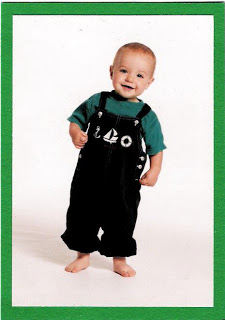
When I watch my 13-year-old singing next to me in the car, or even when I look at a picture of his smiling toddler face, I still see limitless potential – and unnamed possibilities. Not teenage angst and not the Homelander Generation.  I am optimistically looking forward to discovering what his generation teaches us about themselves and our world.

And as a parent, I can teach my child that labels aren’t everything.  Not Urban Outfitters or Juicy Couture.  And not Generation Z or Generation I.  And I can teach him that people can grow and labels can change.  The G.I. Generation may not have been all that unique as teenagers either, but decades later they earned themselves a PR overhaul courtesy of Tom Brokaw, and became The Greatest Generation.

Just in case, I’ll keep a space open on my bookshelf for the 2050 bestseller, The Greatester Generation.  Actually, I’ll probably just have to set aside some memory for it on my e-reader.

Objects In Mirror Are Closer Than They Appear

(Originally published March 5, 2010 at playgroupwithsylviaplath.com)

As if anyone needed proof, it’s been a really long winter…
IMG_0087.jpg
Like many in his gender, Slim likes to throw around numbers, statistics and dates the way most women can be dropped in a grocery store like a military recon mission and know instinctively where the produce, eggs and bread are located. (And need we even ask the question, which one of these skills actually keeps the family fed?)

A few weeks ago, he floated this one out there. “Did you know that forty percent of women have had car accidents in their own garages?”

Seasoned by his particular line of baiting, I immediately brushed him off with a convincing, “That is ridiculous. That is totally made up.”

“No, it’s true,” he went on. “And you know what else, 100% of those women think it’s not funny.”

I thought this would set off a round of women screwing in light bulb jokes, or a discussion of the years-old claim that a woman over 40 was more likely to be killed by a terrorist than get married.

But no, he was content to stick with women challenged by the confines of their own homes, or rather garages.

“If you don’t believe me, prove it,” he said.

Happily rising to the defense of my gender, I checked with insurance agents, drivers ed instructors, homebuilders, commercial parking lot designers, and body shop specialists. None could give me any hard data on the postulation.

However, they were each happy to share countless stories of women drivers who had indeed come in too close contact with their own domestic structures.

“It happens all the time,” said my local body shop, which repairs over 1,000 cars a year. “It’s always, ‘I didn’t see the car,’ ‘I didn’t see the pole,’ or ‘I didn’t see the wall.’”

As for those walls that seem to jump out of nowhere, builders told me of routinely having to return to clients’ homes to repair the door frames, garage doors, the actual garage walls, side-jambs, and even the drywall at the front of garages that bumpers mysteriously break through.

Over the last few decades, garages and their attendant doors have steadily grown to meet the demands of larger cars, and perhaps increasingly distracted drivers. A standard double car garage door used to be 16 feet wide by 7 feet high. With many SUVs and minivans measuring in at over 6 feet high, 6 feet wide, and a whopping 18-plus feet long, that would be a tight squeeze.

Garage doors are now made a standard 8 feet high and are commonly broken down into two 9 or 10 feet wide his and hers bays. Plenty of room for a $600 collapsible stroller to be moved without collapsing.

It would appear, however, that this additional width might not have solved the problem.

Although I’m no statistician, I built a few spreadsheets in my day and can certainly collect a set of data. So, I farmed the question out to 25 friends and family across the country – trying to account for city dwellers and suburban types, number of kids, size of vehicle and even style of driver. Yes, I’m equipped to judge my circle.

I’ve looked for all kinds of angles to spin the data, but sadly, it comes out that nearly 70% of women have had some type of altercation with their own garage, driveway or mailbox.

And a note to many of my friends who started their replies with “no” and followed that with “however,” “except,” and “actually.” You could have just skipped the “no” part.

Buried in the numbers, replies and explanations, there were some real treasures. I promised to protect the innocents, but these are my people and this is why I love them:

I clipped both side view mirrors without leaving my property.

I took out the whole tail end of my car when I backed into a concrete planter. Stupid thing shouldn’t have been there in the first place.

My second incident was when I backed the Volvo wagon out of the garage with the ski rack on top. Put two perfect circular holes in the garage door that was hanging above the car.

Addendum to the note to friends: numbering your incidents is not in your best interest.

I didn’t judge how far the boat trailer stuck out in the driveway, and it ended up right in the back seat through the hatch.

If it’s worth getting there, it’s worth getting there fast. I had my pedal down all the way while backing straight out of my curving driveway and a huge tree popped out of nowhere to shatter my back window.

Actually, the only driving altercation I’ve ever had was in our driveway—backed right into another vehicle. What can I say? It was where I needed to go.

Of course there was the time I was multitasking and forgot to close the back hatch before I exited the garage. Calling my husband was not one of my favorite phone calls to make…

And let’s face it, once you’ve made that phone call, explaining the incident to the insurance agent is easy.

“Oh sure, we get a lot of claims of women hitting their garage doors,” said an Allstate specialist. “But the highest claims we see from women are probably parking lot instances.”

Ah yes, the challenge of maneuvering a beast of a vehicle into a 9 foot opening, while reading an email that lacrosse practice has moved fields and your eight-year-old explains that he didn’t mean to spit his gum in your hair. He was just laughing so hard.

Well, parking lots are no laughing matter.

China is not exactly the first nation that springs to mind when you hear “female-friendly.” (This is where my kids would say, cough–cough, one-child policy, female infanticide.) However, the nation hit the news several weeks ago after a shopping center opened a dedicated “car park for women.”

The parking lot’s spaces are three feet wider and the lines are painted in pink and light purple to “cater to women’s strong sense of color and different sense of distance,” according to officials.

The news set off accusations of gender stereotyping and sexism round the globe. Sure, it’s a bit presumptuous and debasing. But, ladies stop with the doth protesting too much. What’s wrong with bigger parking spaces? At our golf club, there’s a flat screen television in the men’s locker room but none in the ladies. And trust me, Slim’s not clamoring for change saying “Hey, that’s sexist.”

Besides that would just encourage my middle, who received the movie Spinal Tap for his 10th birthday, to say, “What’s wrong with being sexy?”

I decided to see if these generous parking spaces were going to become an international trend. And for that, my local mall took me straight to the top. The King Of Prussia Mall is the largest retail space in the country (apologies to Mall of America, an indoor amusement park doesn’t count as shopping).

With over 13,000 parking spaces, I was curious, would they be widening any of them with their largely female consumer base in mind? But alas, no. No larger spaces and no light purple lines, although they do have valet parking and shuttle bus service during the holiday season.

So, as much as Slim would like me to end with: “And my husband was right.” I think I’d rather leave you with an observation from a wise drivers ed instructor.

“One thing I notice with drivers is that there is more or less an inverse relationship. The brighter the person, the more difficulty they have picking up some of the basic concepts of backing out and parking.”

Olympic Fanfare Part 2

(Originally published February 24, 2010 at playgroupwithsylviaplath.com)

I could go on and on with my love of all things Olympic, so I’ve decided to break my piece into two parts. Breaking all kinds of blogging rules at the same time, I’m sure.
flag 2009-05-25.jpg
For as much as I love these two weeks in February, I do have one little pet peeve. It’s 8 lines long and, according to Olympic rules, can last no longer than 80 seconds. It’s our national anthem, and why none of our athletes seems to be able to sing it on the medal stand.

I’ve watched an almost embarrassing amount of Games coverage now, including a half dozen medal ceremonies. I have yet to see the winner join in song when his or her anthem is played. Sure, they’ve just won a gold medal for themselves and their country. How can I possibly expect them to sing? But I do. I want them to sing it. Quietly to themselves, or as loudly and off-key as I sing in my car.

Obviously, every athlete goes to the Games knowing the ultimate goal is to stand on that middle platform. So why do they all look so lost, confused, and surprised when the music begins? Poor Alexandre Bilodeau, the first Canadian to ever win the gold on home soil, looked like a (charming) deer in headlights as the Maple Leaf flag went up. You’d think that Canada’s $120 million campaign to “Own The Podium” could have covered a lesson or two on Oh Canada.

A study in 2004 showed that two out of three American adults could not sing the national anthem. I decided to test the numbers on my own Americans. Thing One belted out the full verse a cappella with pride. Thing Two claimed “stage fright.” And Thing Three got stuck in a perpetual loop of “dawn’s early light.” But, our Olympic athletes have shown us we can expect more from them.

We all know The Star Spangled Banner was taken from a poem Francis Scott Key wrote as he waited to see who would emerge victorious when the British Royal Navy took it to our young nation in the War of 1812. And it’s not metaphoric. The rockets and bombs really were bursting in air, but early the next morning 15 stripes and 15 stars rose above Baltimore Harbor and Fort McHenry. The Fort is the only National Historic Shrine in the country and was the first site ever allowed to fly the flag night and day, 365 days a year. And whenever our flag was changed to add a new star, it flew over Fort McHenry first so that the quilted cloth would indeed become The Star Spangled Banner.

The song’s first association with sports was baseball’s opening day in Philadelphia in 1897, but it became a game fixture during the Boston Red Sox 1918 World Series win (Slim would tell you that’s when modern history as we know it began). President Herbert Hoover declared The Star Spangled Banner our national anthem in 1931.

The tune has been played a remarkable 7 times already at these Games, yet only snowboarder Seth Westcott has attempted to mumble his way through the verse on the podium. I expect Bode Miller thought it would be difficult to chew his gum and sing at the same time. However, my oldest proved in the third grade that one can play an entire recorder concert while chewing gum. I think Bode could have managed it.

Some athletes have taken their hats off, and some have even placed a hand over their heart and faced the flag, as is protocol laid out by the official U.S. Flag Code. There is no mention of the common conundrum of what to do when wearing a tiara during the anthem.

But what about the singing? The U.S. Olympic Committee has tried to script and control every aspect of the team’s appearance and behavior (what to wear when, and no tweeting or Facebooking until March 3rd), so it would reason they might also help our 216 athletes prepare for the podium.

To find out, I asked a U.S. Olympian – who happens to sport at least one medal of every color, and indeed did sing as our flag was raised. “The US Olympic Committee requires you to attend orientation and one of the items is ‘singing the national anthem,’” he said. “They gave us the words but told us NOT to sing if you don’t know the words. The USOC thinks it’s disrespectful when the words coming from the athlete’s mouth don’t match the anthem.”

You’d think that if our athletes can train up to 11 hours a day, that they’d be able to memorize 8 lines. As for the singing, if you’re sporting gold, nobody cares if you’re off key. When the hockey team beat the Russians in 1980, they spontaneously sang God Bless America – and with their discordant Boston and Minnesota accents, it couldn’t have been pretty. Yet I’m sure they all sang the anthem two days later when they received their gold medals.

But they weren’t singing it from the podium, as the platforms were only intended for team captains back then. After the flag was raised and the anthem sung, our U.S. captain invited the other 19 Americans to squeeze onto the stand with him. Since then, Olympic podiums have been enlarged to accommodate an entire team of gold medalists.

And that’s why I love the Olympics.

Olympic Fanfare Part 1

(Originally published February 24, 2010 at playgroupwithsylviaplath.com)

ODBmacclanahan.jpgI love the Olympics. Everything about them. The sports, the athletes, the stories, the drama, the medals. As I write this, the women’s moguls are on in the background, and I’ve even changed my ringtone to the John Williams’ Olympic Fanfare theme. Really. Call me. I love it when it rings.

I remember watching Dorothy Hamill in 1976. She not only won gold, but taught every girl how to wear her hair for the next five years. Slim can detail the entire saga of the US hockey team’s march to gold in 1980. Thirty years ago today, 20 American boys (and I do mean boys – average age of 22) won the gold medal by beating Finland after besting Russia two days earlier in the Miracle On Ice. At the time, Slim was twelve and playing in a PeeWee hockey tournament himself, which was stopped for the announcement that the Americans had won gold. And yes, he was carrying the puck at the time. American boys remember these things.

Now with kids of my own, I love the Olympics even more. For one, it is the best excuse to let them watch television with zero guilt involved. And I’m not alone. Apparently, the Winter Games are watched by more women than any other sporting event. And clearly advertisers have gotten the memo. I was a fan the first dozen times I saw the Proud Sponsor of Moms commercial, but by now I can hear the wheels of the marketing machine churn around me.

Watching the games as a family can also bring up a surprising number of issues. Citizenship, politics, history, and geography. The difference between socialism and communism? Shhh, just watch the ice dancing.

My oldest roots against China because they’re against the Dalai Lama. My middle is not a fan of skating for the Republic of Georgia if you were born in Michigan. My youngest is taken with curling because “they’re working really hard sweeping out there.” And my husband roots for Australia because he’s a fan of Torah Bright.

The Olympics are the original reality television. These are real people who’ve sacrificed and trained for years for the chance to compete for a gold medal. Their dream came true when they made it to the Olympics, now they are trying to make ours come true watching them. Most of the athletes are anonymous when they arrive, and many are anonymous when they leave. Regardless, they are Olympians. They have competed at the top of their game on the world’s stage. The phrase “world class” takes on the meaning it was meant to have.

The United States has won more gold medals than any other country, bringing home the gold just over 1000 times since the modern Olympics began in 1896 (and only 85 of those in the winter games). Accounting for summer, winter and team sport wins, there are 1,493 Olympic gold medals residing within our borders. Not something you get to see everyday.

When the movie Miracle came out in 2004, we were invited by a bank to preview the film and meet one of the players from the 1980 team. Obviously, that was back when financial institutions were allowed a more generous definition of “customer service.”

Thing One, all of six years old at the time, invited a friend within whom the hockey blood also ran deep. I remember the two boys mapping out what moves they were going to try on this Olympic great, and what they would say to the Russian and Finnish teams, which in their minds, would obviously also be at the suburban shopping mall multiplex. I was too busy trying to control the unruly sticks they’d brought for autographs to break the news that it was unlikely that the Finnish National team would be at the King of Prussia Mall.

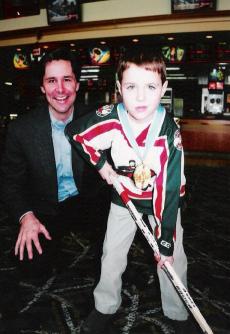
Needless to say, they were a little disappointed to find a man in a business suit standing next to the popcorn “topping” dispenser. There was no Russian goalie and no Finnish hockey team. Just a rep from the bank, 1980 forward Rob McClanahan and his Olympic gold medal.

And indeed, he was world class. He talked to the boys about their teams, told them to work hard and even let them try on his medal. And he didn’t appear offended when they asked why he put it on a light blue ribbon, shouldn’t it be red-white-and-blue?

The other night I asked my three what they would do if they were fortunate enough to take home the gold. Thing Three said he would wear it around so people could look at it. (Presumably not dangling from his waist. For shame, for shame, Scotty Lago.) Thing One said he would have it framed and hang it on his wall. Thing Two, who is worldly beyond his ten years, said, “I’d get it appraised.”

And how would they like to win those medals? Snowboarding. Ice hockey. And “anything but figure-skating.”

This year my children have made Olympic memories of their own. They are completely taken with Shaun White and his helicopter-access only secret half pipe. They’d really like to get their hands on some of those US snowboarding team gloves with the flag on the palm. They say that our U.S. women totally dominate. And they have watched Ryan Kesler’s last minute open net goal against Canada a half dozen times.

Watching the first-time Olympian skate down his opponent and reach around to make a backhanded sweep at the puck with 45 seconds to go, you’d never guess he was cut from every high level team he tried out for when he was 13 years old. Cue the music, because that shot teaches you to believe in Olympic dreams.

And years from now, at a strip mall sporting goods store or a suburban elementary school’s Winter Carnival, a new host of seven-year-olds just might have the chance to touch Ryan Kesler’s gold medal if the Games continue to go our way. And that’s how Olympic dreams are passed on.


Making Peace With Sylvia Plath

(Originally published onFebruary 19, 2010 at playgroupwithsylviaplath.com)

While “celebrating” the 6-day weekend with my three kids during Snowpocalypse 2010, I had the ingenious idea to avoid the oven and grill. It turned out to be less than genius.

IMG_0060.jpgEven in just a few weeks of writing this blog, it has come up more than a few times. Sylvia Plath, isn’t that a little dark? Isn’t she dead? Is Sylvia Plath really in your playgroup? And, who’s Sylvia Plath? Granted, I’m related to most of the people asking these questions.

However, it raises the topic nonetheless. Yes, the author Sylvia Plath is indeed dead after asphyxiating herself in her oven while her two young children napped in the next room. And, as if there was any doubt, it did happen during the month of February. So, yes, parking oneself in a mothering club with Sylvia is ironic, sardonic and dark. It is also the truth.

I’m not saying that I should be put on watch or that I don’t enjoy being a mother. I am only saying that there is a very, very dark corner to motherhood and that being able to acknowledge that has not only made me a better mother, it has also allowed me to enjoy the role more. And for that, I have Sylvia Plath, Andrea Yates, Maggie Young, Susan Smith, Melanie Blocker Stokes, and hundreds of other women to thank. Because of their own deeply personal and grisly tragedies, I have learned one of my life’s most important lessons. Mothering is thathard.

When I was pregnant with my first, I went back to Manhattan to visit one of the few people I knew who had a baby. The babysitter had her nine month old out for a walk, and as we sat in her fabulous Madison Avenue kitchen, I waited for my friend to tell me how all of this fabulousness soon would be mine.

“Until I had a child of my own, I never understood child abuse,” she said as she calmly stacked our luncheon dishes and moved on to the sink. I was speechless and desperate for something to busy my eight-month pregnant self. Only weeks later, I viscerally understood that truer words were never spoken. Certainly, motherhood is a very big continuum, be we are all decidedly on it.

In my baby days I kept a mental clip-file of these stories of women who’d gone before and failed by ending their own lives or those of their children or both, as grim testimony to the challenge of motherhood. And that meant some crying and some screaming (on my part) was more than okay.

I also had another little file for Kenny and Bobbi McCaughey and their septuplets and their 15-seater van outside of Des Moines, Iowa. That was my “it could be worse” file. Over the years I have augmented the file with such gems as Nebraska’s safe haven law, which allowed parents to abandon children of any age at hospitals, no questions asked. Nothing like indulging in a little dose of domestic schadenfreude to make my own fortunate lot a little easier.

Only now, when I am far from those dark corners of the early years of motherhood can I consider the subject academically. To that end, I’ve found two academics who’ve taken up the subject full time. Professors Cheryl Meyer and Michelle Oberman write books, comment on trials, speak at conferences and receive weekly phone calls when a new tragedy strikes. “People need to realize, some of it is hormonal and some of it is the social construction of motherhood. And we need to address both,” Meyer says. “People who were close to the woman always say, ‘she was such a good mother, such a devoted mother.’ She’s always, always described as ‘a devoted mother.’”

Their important work is aimed at increasingly awareness, understanding and help for women and families so that such extremes can be avoided. “The media tries to spin it ‘this couldn’t happen to you.’ When the reality is exactly the opposite, this could happen to anybody.”

Such was the case last summer. I was with friends when someone mentioned the story of a local mother who was pushed to – and over – the edge when she put her hands on her daughter’s mouth to make the screaming and crying before a bath stop. It did, and so did the girl’s breathing.

The collective reaction from the gathered group of women was, “Oh my God, that’s awful. I can’t believe that happened.” Then, leave it to one in the crowd to say, “I can’t believe it doesn’t happen more.” And, if you’ve ever wondered how to clear an entire deck at a summer tennis club, then consider that my little gift to you.

But it does happen more. There are over one hundred cases a year of children dying at the hand of their own mothers. That’s one every three days. These were not violent women and they did not have any criminal histories. At its simplest, they were women whom mothering had gotten the best of. And what they were left with was often depression, inadequacy, isolation, too many babies and not enough money, and crying that wouldn’t stop. And most insidious of all, they were left with a reality that did not match the dream.

And whose does? No one but another mother will believe you when you say that those most magical baby days can be the loneliest, darkest, most isolating and angriest you will experience. Sure, you are surrounded by people bearing gifts and good wishes, and the baby is fast asleep. But your guests will leave as soon as the baby wakes and you are left with the seemingly insurmountable task of writing a thank-you note for a hooded hippopotamus bath towel. And your husband will ask why he is having toaster waffles for dinner.

And for many in the great sisterhood of motherhood, it doesn’t seem to get any better. Yes, I could afford the toaster waffles and I had a husband to eat them. Many have neither but have two or three times as many babies as I. However, as the academics discovered, these extreme cases of helpless and hopeless follow no pattern for birth order, religion, time of year, age of mother, age of child, gender of child, or number of children. It would appear isolation and exhaustion are doled out fairly equitably in motherhood.

I fortunately seemed to get more than my share of irony and dark humor. Which helps explain why I write Playgroup With Sylvia Plath and will never have to be described as “such a devoted mother.”