
Studying The Recent Studies

(Originally published June 17, 2010 at playgroupwithsylviaplath.com)

Admittedly, most talk of the health care bill and the state of medical care in our country causes my eyes to glaze over.  (Apologies to my many friends who are talented, valuable doctors.)  But this spring, some new research was released with quite a splash that did catch my attention.
136618585v4_480x480_Front_Color-BabyBlue.jpgThe recent study said that the lives of 900 babies could be saved along with billions of dollars in lost employee wages if 90% of American women breastfed their babies exclusively for the first six months.  I am not sure which part of that goal stuns me more – the 90%, the six months or the “exclusively.”

When you really think through those demands, it is no wonder that only 12% of American mothers currently comply with that goal. And they’re hoping for a 600% improvement – even for the government, those are some pretty high expectations.

Sure, I’m all for solving the deficit and saving lives, but aren’t there far more insidious foes out there than suboptimal breastfeeding rates?  For example, smoking during pregnancy is said to cause more than 1,000 deaths annually.  And yet, more than 12% of women report smoking during the last three months of pregnancy.  I’ll go out on a limb of deductive reasoning here and say that 12% is not the same12% that breastfeeds exclusively.

I lend full support to the efforts of the study The Burden of Suboptimal Breastfeeding in the United States – breastfeeding-friendly legislation, more support for nursing mothers in the workplace, and more breastfeeding help for new mothers in our hospitals.

However, a goal of 90% of American mothers to breastfeed exclusively for six months is an effort I cannot rally behind, and nor frankly, as a woman and citizen, do I think it is a very healthy goal.

Sure, doctors and researchers have been able to put numbers and dollars on losses due to the nation’s breastfeeding rates.  But, what they haven’t looked at is what these “suboptimal” rates have prevented or gained for American women, children and families.  Where are the statistics on how many marriages have been saved by limiting breastfeeding?  Or simply what post-partum independence has meant for women’s mental health, and their confidence and trust in their relevance outside the domestic sphere.

When baby comes home from the hospital, there are those few first magical days of shared responsibility with your lab partner.  And then inevitably, someone’s got to take charge.  With breastfeeding, there is no question who is in charge, the authority, the source, the expert, the ultimate backstop. And for many, so begins the road of resentment.  A road on which it is very difficult to make a U-turn.

For many women and couples, having a baby is an epochal event after which a tenuous level of shared responsibility and psychological equality can be recovered.  Half a year of exclusive breastfeeding would make such reparations nearly impossible.

I suffer this bizarrely narcissistic relationship to many of the challenges of parenting and find myself frequently thinking, “If it’s this hard for me, imagine what it’s like for…”  Breastfeeding was no exception.

For me, nursing was fine.  Which is a far cry from saying it was easy.  I can still recall the nights with my firstborn when we’d play our own little game of, who can cry longer, baby or mother?  And of course, it’s strategic cousin, who can cry louder?  (That one was more fun during daylight hours while Slim was away.)

I nursed each of my children for respectable terms – 3 months, 5 months, and an almost embarrassing 10 months.  I stayed at home, I worked, I used a pump (and there is nothing stylish about the Pump-In-Style). I nursed in the Nordstrom’s “Mother’s Lounge” and pumped in The Gap dressing room.  I breastfed in the front seat of the car on I-95, though never while driving.  I even breastfed on a bathroom floor in Dallas wearing a bridesmaid’s dress.  It was novel, it was never elegant, and it always struck me as more science fiction than biblical.

I do not resent breastfeeding, my children, or my nearly perfect husband.  I do resent the expectation that after carrying a baby for nine months, that American women should surrender control for six more months.

Because really, it’s not just the physical and time commitment that breastfeeding takes (which at 6 to 18 hours a day is, no doubt, significant).  Being a nursing mother overrides everything.  It dictates what you do and don’t eat and drink, your sleep schedule, and where you can go, when and for how long.  It even holds sway over what you wear.  For an entire six months.

If that weren’t enough, the real rub is what women give up psychologically during that time.  There’s the illusion that you can return to any previously held status of equality at home or in the workplace, and that others’ perception of you, your value, and indispensability will not be affected.  Well, that notion is a four-ounce Avent bottle of expressed milk gone bad.

An entirely different, more compelling study was released just last month: You Can’t Be Happier than Your Wife: Happiness Gaps and Divorce.  I know, sounds like complete common sense, but I love a good study by German experts in “economy and wellbeing.”  And here’s what they found: the happiness gap increased when the wife handled most of the housework.  As they say in German, duh.  But they also discovered that unlike other benefits in a marriage, happiness cannot be redistributed between spouses.  You can share happiness.  And be happy for one another.  But his happiness cannot become her happiness.

Its conclusions?  “When spouses “agree” on too unequal a distribution of welfare, this puts the durability of their marriage at risk… public policy should avoid giving spouses incentives that lead to diverging levels of happiness. Individual income and employment have been shown to be among the main determinants of happiness; policies that affect the division of labor inside households should keep this in mind.”

In a word, be careful what you wish for.  Blue-ribbon breastfeeding goals could — in the extreme — lead to increased divorce, depression, and long-term damage to the delicate ecosystem of gender roles in our families, workplaces and society.  At the very least, the effort sanctions the message to women that their children and domestic duties come first.  For women and researchers for whom long-term breastfeeding is the answer, the question certainly needs to be asked, at what cost?
Oh Captain (of Industry) My Captain!

(Originally published May 24, 2010 at playgroupwithsylviaplath.com)

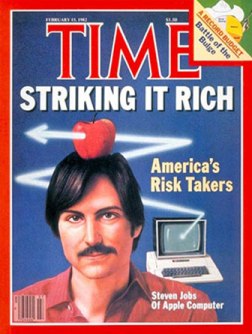
Let’s just start with it.  While other girls taped up pictures of Duran Duran, Rob Lowe, Eddie Van Halen, and Matt Dillon, in my high school locker, I hung pictures of Steve Jobs.  And my friends (yes, I had some, despite the previous sentence) let me.  The fact that I also hung pictures of Wayne Gretzky and Ivan Lendl means I clearly missed the memo that looks were really the point of high school hero worship.

STEVE-02.jpgAnd trust me, you can’t find pictures of Jobs or Lendl in your average Tiger Beat or Teen Bop magazine.  No, my pinup pictures of Jobs were from Fortune and Time magazine.  When I asked a friend last week if she was familiar with the covers, there was immediate recognition, “the one with the 1970s porn mustache?”

Yep, again, missed that memo on looks.  But he had the glow of success, mystery and brilliant boy wunderkind about him.  If Matt Dillon had bad boy Outsider appeal, then Steve Jobs had bad boy confiscating parts of his mother’s blender to change the world appeal. And therein was the attraction.

See, when I was 12 I had the rare thrill to meet and chat with Steve Jobs.  It was an awards conference for people who’d done uber-nerdy things.  Even though the organizers dubbed it Gathering of The Greats, Slim is right when he refers to it as gathering of the geeks.

When it came to making conversation with Steve Jobs, a few of my brethren with thick glasses and I would ask about computers and he would ask if we liked fishing.  We were quite clever in telling him that he could invent a program for fishing on his computer. (I won’t actually demand royalties for iFish, but let’s just say, the seed for the game was planted long ago.)

But even when I was twelve, I got it.  He urged us, begged us to have a host of experiences and try new things.  Don’t just study, and focus on grades and the next achievement award.  (Granted, that’s easy to say when you’ve likely flown in on your own plane to pick up your award.) In order to contribute to society in a meaningful way, you had to acquire not only academic skills, but you also had to experience life emotionally, intellectually and passionately to see needs and solutions in our world.

I recently made my boys listen to the speech Jobs gave at the conference in 1982.  First I showed them the cassette tape it was recorded on, and explained that it was actually a precursor to the flash drive back in my early computing days. (And if you ever need someone to write an if-then statement that will loop your name on the screen, I’m your gal.)

They were not all that impressed with the cassette and only marginally more so listening to Jobs’ words of wisdom.  He spoke about what it means to be intelligent and the challenge to find some way to give back when you do have gifts. He defined real intelligence as akin to being on the eightieth floor of a building while everyone else is on the ground trying to find their way with a map.  I thought him brilliant back then, and I still find this to be a great way to describe being smart.

When the speech ended, I asked my boys what they thought.  Two tried to be complimentary, while the middle was busy asking his brothers how the world looked from the parking garage and the sub basement.

You see, we’ve been talking about Steve Jobs at our house a lot lately. Because when you reside somewhere between the 3rd and 4th floor of that building, you can get yourself enough freelance assignments that Apple will give you an iPad for a month on “editorial loan.”

Once again, we are in awe of Steve Jobs, Apple Computer, and the magic that can be made when you have innovation, a bag of experience, oodles of computer programming and luck. And perhaps my boys are just even the tiniest bit in awe of their mother – because for about three days there, the playground smack was, “Does your mom really have an iPad?”

I find it a remarkable feat of individual endowment as well as a testament to our times that my children and I could potentially hold up the same person as an object of admiration. Neil Armstrong, Michael Jordan and Sandra Day O’Connor do not appeal anew to multiple generations, but Steve Jobs has.

When my teen reverie for the likes of Margaret Thatcher and Steve Jobs takes over, Slim chimes in, “Make sure you mention that he is a control freak who backdates options and doesn’t tell shareholders he has a terminal illness.”  Corporate blemishes, I say.  Even the Greek heroes were endowed with human weaknesses.

In the years (okay, decades) since hearing him speak, Jobs’ words have come back to me periodically.  And although I may not have been a poet in Paris, visited lepers, or bought a Buddhist monk lunch – all experiences Jobs recommends to take you on a winding path – I have remembered his advice.  He was adamant that we be very careful when defining the term “success.”  And to know that it is possible to be very successful and happy without being a “rags to riches” story.  And as an adult and parent today, I recognize the wisdom in those words once again.

In today’s world of competitive parenting, accelerated classes, elite youth sports, and private college admission consultants, any yield sign is good.  Hearing the words of Steve Jobs is a reminder to help my kids find a passion before a profession, teach them that they can change the world rather than just letting the world change them.  And that fishing can be just as important as solving x for y.

Remembering my high school locker, I asked my oldest about his heroes and people he admired.  Now, lest you think this is normal dinner conversation at our house, right away he said, “Are you writing about this?”  But he played along and named some of his favorite sports and music stars – Jay-Z, Will.i.am, Patrick Roy, Dustin Pedroia and Claude Giroux.  And then he said, “and probably Steve Jobs.”

Sure, there’s a decent chance he’s gunning for an iPad of his own. There is also the distinct possibility that the figurehead of iTunes, iPod, iTouch, and iMac is on his list of heroes.  Perhaps most likely is a combination of the two.  And if my boy has figured that somehow my hero being his hero is just one more step in his master plan to get an iPad, well then I think the elevator just let him off on about the 17th floor.

All Hail National Babysitter’s Day

(Originally published May 6, 2010 at playgroupwithsylviaplath.com)

DSC_0023 - iPhoto Edited.jpgObviously this Sunday is Mothers’ Day.  Or, as a friend of mine calls it, Mother-In-Law Day.  Certainly, you’d think that as a daughter, a daughter-in-law, a mother to three children, and a bona-fide blah-ger I’d have lots to say on the subject.  Let’s just call it a Sunday and move forward.


Or backwards as the case may be – to Saturday.  Because this Saturday is in fact National Babysitter’s Day.  Now there’s a subject near and dear to me.  It would be easy to write a tribute to all the gals – and a handful of guys – I’ve gladly paid so that I could work, go to meetings, grocery shop, eat dinner out, or even, I’ll admit, sit in my bedroom and read.

But I won’t.  Instead, because this is a “blog,” let’s talk about me.  And what I think.  And I think that knowing a babysitter, having a babysitter, and paying a babysitter is a thrillingly, freeing milestone of parenting.

There are many, many parenting landmarks that I have been or will be slow to reach.  Affording myself the confidence and luxury to hire a sitter has not been one of them.  And I mean this in all seriousness.

Certainly with a baby, hiring a sitter is an absolute necessity.  After enough weeks at home with an infant, the visiting grandparents leave and the sun stops rising and setting over the weigh-in at the pediatrician’s office.  At some point, it’s time to put on actual clothes and leave the baby behind.

Early on – and to this day – that act of handing my baby or my children over to someone else for a few hours says a number of significant things.  Perhaps most importantly to me, it means that my circle is large enough that I actually know people who babysit – or at least I know people who know people.

As a mother at home, it thrills me to count in my company high schoolers, college kids, part time cafe workers, grad students, and the neighbor’s boyfriend’s sister.  And each of these individuals makes my children’s world larger and more textured as well.  My kids will ask for the sitter who helps them make music mixes, or teaches them to string a lacrosse stick, or brings her beading supplies to share, or is king of basement floor hockey.

It’s also useful to have in my back pocket that one sitter I know they fear.  “No, no not her! She just does her homework and yells at us. We promise we’ll be good. Anybody but her.”  Obligingly, I call the favorite sitter who runs the family room dance contest, and harmony reigns for all.

I know for many parents having a babysitter creates more anxiety than it seems to be worth. And some put babysitters through “dress rehearsals” while they are still at home before they consider leaving them to do the job alone.  There are also plenty of parents who will only leave their children with family members – no outside sitters allowed.

Granted, you can only do what you are comfortable with as a parent. But, to me, such a policy drastically limits your options for freedom, and it also seems to foster a distrust and anxiety about the outside world.  Parenting is difficult enough without having to fear every tree nut, legume, shellfish and individual outside the family.

When our firstborn was several weeks old, the momentous occasion had arrived. It was time to leave  our only child with an outside sitter. As we drove away and headed to the movies, Slim asked if I knew our babysitter’s last name.  I told him I was pretty sure her first name was Kelly.

When we became parents, I had the supreme luxury of having a cousin majoring in nursing at a nearby college. Her roommates, also nurses-in-training, were the cutest, most enthusiastic bunch you could dream up – just ask my husband.  And with one call, I’d take anyone – we couldn’t go wrong.

Leaving my child with someone else meant that I had the self-confidence to admit that babies and motherhood were not all consuming and that I still had other ways to spend my time.  Paying a sitter is also the best way to free yourself from the guilt and the debilitating notion that you are the only one who can do it.  I have indeed left my children in the hands of capable 12-year-olds.

Hiring an outside sitter also serves as a much needed shot of praise and approval for a mother at any stage.  It seems to be part of the babysitter protocol to tell parents how great the kids are at the end of the job. Yes, I’m usually handing over a small stack of tens and twenties at this point, but I choose to believe they are sincere every time.  (Note: those who use family to babysit have assured me that this endorsement of one’s mothering is in no way part of the evening’s transaction.)

It is only after you’ve had a sitter a good many months and you tell her that you are writing an article for Parents Magazine about putting your baby on a schedule that she feels comfortable enough to burst out laughing.  It is at this point that you remind your sitter that she was the one who just waxed her eyebrows using your microwave.

My male babysitters bring their own special gifts and delights as well.  I’ve come home to a room of sweaty, shirtless boys lying on the floor giddily watching Tom & Jerry – including the 17-year-old sitter. One summer night, my sitter asked if I needed him the next day because he’d be back anyway to find the shoes he lost outside in a game of Manhunt.  My youngest declared one boy “the best babysitter ever” because he taught him how to shoot marbles out of his nose.  And I’m quite certain I paid forty dollars for that skill to be passed on to my children.

The actual transaction of paying a babysitter is no small issue either. Every time I hire a sitter to watch my children, I know that my family is economically fortunate.  Not everyone has such luxury. (Strangely, I’m discovering that a lot of my parenting satisfaction comes from that notion of, “it could be worse.”)

It also means that it is a service that my husband and I both feel has real financial worth.  Every time we pay someone, the unspoken message is, this is valued work that someone is paid to do.

Granted, I’m not paid to do it, but the understanding is that if I weren’t caring for our kids we would need to pay someone else to do it.  And when the subject of money and babysitters comes up in our house, I point out to Slim that there is actually a direct correlation between the number of sitter hours we pay for and his happiness.  I assure him this is not a threat or, more importantly, it is not a promise.  It is just an observation.

To observe National Babysitter’s Day I will simply acknowledge to myself the value my sitters have added to the peace, richness, and life of my family.  I will not actually be having a babysitter this Saturday, however, because my mother-in-law is coming to town.  We’ve both agreed to head into Mother’s Day with low expectations and hope to be surprised on the upside.

And so, a happy National Babysitter’s Day to me and the individuals who’ve cared for my children.  A thank you for giving me respite to breathe, for telling me I was doing a good job at valuable work, and, of course, for teaching my children to blow marbles out of their noses: Ali, Alison, Amanda, Andrew, Andrew, Angelica, Anna, Ashley, Becca, Beth, Betsy, Bobby, Caroline, Caroline, Carolyn, Chloe, Christine, Christina, Claire, Claire, Courtney, Eliza, Emily, Erin, Haley, Hannah, Hannah, Hannah, Honore, Hope, Janine, Jen, Jesse, Johanna, John, Julie, Karen, Katie, Katie, Katie, Katie, Kelly, Kelsey, Kristin, Lauren, Liam, Liam, Maddie, Maddie, Maggie, Mary, Mary, Meg, Megan, Meghan, Mikaela, Miranda, Naomi, Nicole, Patty, Ray, Rose, Ryan, Sarah, Sydney, Tara, Tayler, Taylor, Tory, Tucker, Will, and Will.

Play Ball!

(Originally published April 27, 2010 at playgroupwithsylviaplath.com)

For anyone who’s spent more than 60 seconds with me and knows the logistical paralysis I can suffer at the hands of youth sports, this will surprise you.

DSC_0051.jpg

I love Little League.  The season’s opening games happened in our town this month, and I couldn’t be happier.  Mind you, I wasn’t actually at any of my children’s opening games (see above paragraph on me and youth sports).

Certainly, I could write volumes on the benefits and evils of programs my children have participated in – from ice hockey and soccer to sailing and swimming and everything in between.  But I love Little League. Everything about it.

For one, baseball is the most storied of sports.  Writers, historians, poets and politicians have held the game up as the American ideal, the American dream, and the American spirit.  Baseball, at its best, is our national character writ large.  And in Little League, it is that character writ small.

My town’s Little League is just one of more than 7,000 around the world, in which 2.5 million boys and girls will participate this spring.  It’s grown every summer since its first in 1938 – with a few neighborhood kids and a vacant lot in Williamsport, Pennsylvania.  Fill out your form, write your check, and the hat, the t-shirt, the socks, the season, and the American dream are yours.

That’s one of its greatest appeals.  There is room for everyone in Little League, and there are no divisions for elite players, or travel teams.  Players are divvied up as equitably as possible, and the game is never a showcase for the biggest, the fastest, or the strongest.

Men such as Mark Twain, Walt Whitman, Ernest Hemingway, Stephen King, and George Will have penned paeans to the game of baseball.  They talk about the geometric beauty of the field and its near da Vincian dimensions.  They talk of the poetic perfection and the rhythm of the game’s three strikes, three outs, three bases, nine players, and nine innings.

The big league writers can have the Major League.  I’ll take on the game where boys still need help tying their cleats and girls’ uniforms hang down past their knees.  Because Little League is governed by an additional set of immutable laws, and it is precisely those rules that make me love the game.  (And any dad who chooses to quibble with my analysis, well, you can forget me as your “snack mom” next year.)

Unlike most youth sports, Little League begins with the very basics, and size, rules, dimensions, and complexity are added with each passing spring.  The game evolves as its players mature.  It is not, however, a series of checkpoints or milestones the players must pass or achieve.  It happens silently and magically over the hibernation of winter.  As a parent, this process is gloriously unceremonious.  Spring dawns and a new game awaits.

The game begins with tee ball, which any 8-year-old will tell you, is what babies play.  But it is actually where a 5 or 6-year-old kindergartner begins the baseball journey.  The ball is served up, immobile on a pedestal. The batter gets as many swings as it takes.  Every player bats every inning, and rounds every base.  (Which is why Thing Two liked to take up residence around home plate as a fielder — so that he could tag every player, every inning, every game.)  Of course, the game is always a tie.  And there are often as many adults on the field as there are off.  Kids and parents alike are learning the rhythms of the game.

In subsequent springs, tee ball gives way to coach pitch on a bigger field with real bases, an actual backstop and even a players’ bench.  But with these luxuries come the responsibility of strikes, and strikeouts, and three outs an inning.  The reality of winning and losing and the highs and lows of taking your part in each begins to settle in.

Driving Thing Three to his first practice this season, he weighed in from the back seat.  “You know there’s strikeouts this year, right mom?”

Uncertain whether to help him face his fears or boost his confidence, I asked how he would feel about striking out.  He replied, “Oh no mom, I’m not worried about me.  But have you seen David bat on my team?  I’m worried for him.”  So, perhaps the reality hasn’t set in quite yet.

Every child should know what it feels like to strike out.  And to hold in the tears as he walks back to his teammates. And every boy and girl should know what it feels like to be one of those teammates who says, “you’ll get ‘em next time.”

And one of those next times, a batter will send the ball sailing out over centerfield and a lucky kid with an open glove will hold his breath as the ball falls into the leather palm.  And every player should know the thrill of being on both sides of that ball.

Then all of a sudden one spring evening, there is a ten-year-old boy standing on that pitcher’s mound, 46 long feet from home plate.  The dads are now in the dugouts or coaching from the baseline.  The ball and the drama are handed over to boys and girls who have earned that responsibility.

It is also the year when, for the first time, a player will bobble the ball somewhere on the field and that coach on the baseline will say to his runner, “steal.”  And if you’ve watched a team of rule-following ten-year-olds suffer its very first steal, then you understand what it is to be violated.  Just another lesson from the parable of baseball.

One more lap around the bases and those boys and girls are 11 and 12 and there is a fence around that green field.  And somewhere on that fence is a big sign that says “205.”  Some days that yardage number may taunt the batter, and other days it may whisper, “you can do it.”

And that is one of the rarer and finer sites of spring – when a ball takes flight and time stops until the ball lands on the other side of the fence.  No, the lights don’t get shattered and the leather cover doesn’t fly off the ball.  But for all too brief a moment, a child will believe that he can do anything.  Achingly, it happens about the same time that as a parent, you begin to fear that child may never believe that again.

Bart Giamatti, who having been the President of Yale University and the Commissioner of Baseball, had a perfect blend of cerebral respect and awe for the game.  Many of his baseball writings spoke of the significance to a nation of young immigrants of the goal of home plate.

“Baseball is about going home, and how hard it is to get there and how driven is our need.  It tells us how good home is.  Its wisdom says you can go home again but that you cannot stay,” he writes.  He even calls on his Greek to further define baseball, “Nostos, the going home, the game of nostalgia, so apt an image for our hunger that it hurts.”

For Giamatti and other scholars “home” may be the base to return to, but for parents using Little League as one more ally in mentoring our children, “home” is surely the base we are preparing them to leave behind.

And then all of a sudden, one spring, Little League is over.  You turn thirteen and it is someone else’s turn to run the bases and rule that patch of grass.  And every year, there is a gaggle of 13 and 14 year-olds standing around the fence – decidedly not in the game, but not quite ready to take their place as spectators on the bleachers.

If you are lucky enough to watch a small boy or girl with a big dream play Little League on a sunny afternoon this spring, keep in mind my favorite baseball line from Mr. Giamatti, “It breaks your heart, it is designed to break your heart.  The game begins in the spring, when everything else begins again…”

DSC_0057.jpg


What’s The Right Age To Take A Child’s Cell Phone Away?

(Originally published April 14, 2010 at playgroupwithsylviaplath.com)

IMG_0215.jpgI realize for many, the question is usually, “What is the right age to give your child a cell phone?”

Well, in my house, that question had been easy.  With the confidence of an all-knowing parent who’d never had a preteen much less a teen, I adamantly stated my case to the women in my book club a few years ago.

“Kids with cell phones are ridiculous,” I asserted. “Mine will get it when he needs it – the same time he gets his driver’s license.”

Well, imagine my surprise when I found myself in the AT&T store adding that extra phone line, making ours an official family plan as he was turning 12.

He was midway through his sixth grade year and still settling in to the ups and downs of junior high.  He had risen to the challenge of wearing the jacket and tie that sets middle schoolers apart from the “little kids” at his school.  He gladly schlepped hockey pads, squash bags and lacrosse sticks to school everyday – another signal to his immediate world that he had graduated from the elementary years.

But, despite the heavy baggage of those exterior signs of maturity, what he most wanted to symbolize that he was an independent middle schooler weighed a scant 3.4 ounces.  The cell phone.

Like in many homes where adolescence blooms, “the cell phone conversation” was a weekly occurrence.  He would insist that he was the only one without a phone.  When this argument took him nowhere, he reasoned that I could always find him if he had a phone.  I reasoned back that if I didn’t already know where my 11-year-old was, then we had bigger problems than cell phones.

I described our familiar patter to a friend, a father of two other middle school boys, “He’s acting like by not letting him have a cell phone, I’m completely emasculating him.”

“You are,” the friend replied simply.

So, living by the mantra “pick your battles,” I decided that $10 a month was a small price to pay for middle school acceptance.  Obviously, I was not factoring in insurance, texting, taxes and a phone that was more than a tin can with a string.

With that, my son became just one more of the 20 million teens bouncing their cell phone signals off towers and satellites across the American landscape.  He couldn’t have been happier standing with his peers texting after school – likely to the boy standing right next to him. On days I picked him up, he was apt to call and say, “Oh, I see your car, I’ll walk right over.”

How had we managed without this technology for so long?

Studies show that more than 70% of teens now own cell phones, up from five years ago when just 40% of kids aged 8-18 owned cell phones.  And even that number is a drastic jump compared with pre- September 11 percentages.

Before 9-11 most schools banned cell phones on campus.  “But after 9-11 and the Columbine shootings, parents wanted to be able to reach their kids all the time,” explained the head of my son’s middle school. “And now the cell phone is not going away, so we have to learn how we can use it to benefit us.”

For your benefit, here are just a few lessons learned in our year-plus with the gadget:

If your phone is in your sweatshirt on the floor of the locker room, chances are high that a skate blade will find it, thus requiring a replacement.  This is not recommended.

If you give your phone to a group of girls because they want to “program” it for you, it is entirely possible that the speaker will cease to work, thus requiring a replacement.  This is not recommended.

If you are sitting in the kitchen with your mother when her phone rings and it is your cell number that comes up, it is best to fess up that indeed you have no idea where your phone is.

If you are sitting in the car with your mother when her phone rings and it is your cell number that comes up, it is best to fess up that indeed you have no idea where your phone is.

If you decide to prevent further incidents of losing or damaging your phone and begin leaving it safely in your backpack, hockey bag, lacrosse bag, or on the kitchen counter, it becomes increasingly difficult – nearly impossible – to hear or feel your phone when your mother is calling you.  This is not recommended.

If it is your father, who ostensibly pays for your phone, calling when said communication device is stowed safely out of useful range, this is really not recommended.

In just over a year, the cell phone and its tempting trappings of responsibility and independence had become a burden.

Once again, Slim and I found ourselves having “the cell phone conversation.”  And he was the one who captured the situation best, “He can always say had a phone. He lost it and now his parents have taken it away.  That’s a credible narrative.”

Indeed, it was not a week later when the familiar chirp of his phone alerted my son that one of his people had messaged that most expressive mot, “ ‘sup?”  My youngest moaned with envy, “I can’t wait until I can get a cell phone.”

“Trust me, you don’t need a cell phone,” said his big brother. “I don’t even need a cell phone.”  And rather than try to reel his words back in or backtrack on his logic when our eyes met, he accepted and owned the truth of his statement.

He found me later and laid his cell phone on the kitchen counter, just like Charlie Bucket returning the Everlasting Gobstopper to Willy Wonka.  The evils of temptation, Slugworth and sexting had been denied in one fell swoop.

“I just think I’ll be able to relax so much more if I don’t always have to carry it with me and worry about it all the time,” he explained.  “Could you just turn it off for a few months and then we’ll try it again when I really need it?”

I’d love to say that the story ended there, we each learned our lesson and went out for ice cream.  But instead, we learned another lesson called “early termination fee.”  So, we’ll be leaving the phone on, handing our ice cream money over to AT&T and using the gadget as a “special occasion” phone.