
Baby Teeth

(Originally published February 12, 2010 at playgroupwithsylviaplath.com)
IMG_0073.jpg“Mom, I have some really exciting news to tell you,” my eight-year-old said to me when he got off the bus recently. This is one of my favorite things about having a child in the early grades of school. They seem to come home almost daily with some great conquest of knowledge or observation they’ve been keeping in their pocket to share with me all day. “Mom, did you know there are 8 million atoms in a period in a book?”

The exciting news this time from my second grader? “I have a wiggly tooth.” His palpable excitement was crushed quickly by his older brother – all of twelve years old, “You are such a loser.”

“Do you want to feel it?” Because, for an eight-year-old boy, it’s completely normal to ask if you want to stick your fingers into his mouth, grasp his tooth and push it around in a circle and back and forth in his gums. In fact it is so normal that if you say “no,” he will say, “why not?”

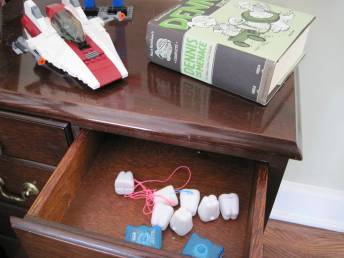
The tooth fell out a day or two later and he was able to add another little plastic tooth keepsake box from the school nurse to his collection. We went through the charade of the tooth fairy – whom he has actually told Slim is spelled M-O-M. Somehow, I find selling my children on the Santa fantasy palatable, yet I have a harder time thinking that convincing them to believe in a magical fairy that exchanges cash for teeth is good parenting.

In many European countries, the traditional belief is that the tooth fairy is a magical mouse. Excepting Scotland, where the little dental sprite takes the form of a white fairy rat visiting children’s bedsides under the cover of night. Now there’s an image that invites a peaceful night’s sleep.

Then just a few days ago, my seventh grader informed me that he has three loose teeth. I refrained from telling him he was “such a loser.” Instead, I got to thinking, why do kids lose their teeth? There is no other body part for which you get a practice round and then regenerate.

And why do kids get their permanent teeth and all of the attendant orthodontic wear right in the prime of gawkwardness? Wouldn’t it be better to emerge once the food groups have expanded from gum, Nerds and Skittles? To say nothing of waiting until a kid can actually be responsible for his dental hygiene more than two nights in a row?

But, apparently no. Our bodies are designed to follow a particular course of growth, development and maturation. And teeth are an important part of that process. In fact, for many who have theorized and constructed timelines on the stages of development, teeth can be important milestones.

Austrian philosopher Rudolf Steiner linked teeth directly to his theories of the 7-year cycles of childhood and learning. A child ages one through seven is busy growing their physical bodies, the central nervous system is getting itself under control and the child is all about himself.

Jean Piaget, a Swiss biologist, called this stage pre-operational. For him, a child during these years is “oriented to the present, the child has difficulty conceptualizing time.” That explains the odd – but frequent – question from my youngest, “Mom, I forget, is this yesterday or tomorrow?”

Piaget goes on, “His thinking is influenced by fantasy – the way he’d like things to be. He takes in information and then changes it in his mind to fit his ideas.” Piaget would like this one, “Wouldn’t it be awesome if there was a giant gumball machine robot in our backyard, mom? Wouldn’t it?”

When the primary teeth begin to fall out, this is the beginning of the end of early childhood. Steiner’s Waldorf schools go so far as to all but require a missing tooth to enter the first grade. It is seen as a sign that the mind is ready to take on the task of learning to read.

Of course being slightly on the touchy-feely side, there would be no chart of who’s lost how many teeth in a Waldorf kindergarten. The “lost teeth” charts have even been phased out of many traditional schools, as the perceived competition has only added to children’s anxiety. And really, it’s important for everyone (parents especially) to understand, just because Lauren has lost four teeth doesn’t mean she’s gifted.

Even my pediatrician and orthodontist agree, once the top four and bottom four teeth fall out, there is a period of latency. A few years for the body – and the parents of that body – to catch their breath. It’s generally a period of health and happiness.

For the theorists, the years between the loss of the first and the last baby teeth is middle childhood. It is the stage of the concrete. Kids begin to gather a body of concrete knowledge, facts and observations and make rational judgments. The world becomes much more black and white, and there are no longer fantasies of gumball machine robots. As awesome as those would be.

And then, somewhere between twelve and fourteen years old, the proverbial other shoe, er teeth, drop and adolescence begins. To the theorist, this begins the stage of abstract thinking, opening up the youngster to issues of morality and ethics. Ah, yes the teenage years, the last seven-year stage in the cycle which will wind from adolescence to adulthood.

That stage still feels far away for me, but I know that it gets closer every time I see my oldest put his (filthy) hands in his mouth to wiggle a loose tooth. I wouldn’t mind if he held onto those last teeth for another few years. Because this is what those European scientists say about the teen years, “adolescents perceive future implications, but may not apply them in decision making.”

When I opened up one of my littlest boy’s bedroom drawers, I found his handful of lost tooth boxes. I know that eighth tooth will fall anytime now. And then he will close the drawer on early childhood. And unfortunately, I have no difficulty conceptualizing time. Very clearly, that will be yesterday, and my tomorrows with my three boys will be one less.

A Google Search For Meaning

(Originally published February 9, 2010 at playgroupwithsylviaplath.com)

Thing One returned from a squash match yesterday to tell me that he didn’t finish all of his homework in study hall because they were busy watching commercials from Sunday night’s Super Bowl. Ah, now there’s my education dollars at work.

imgres.jpgBut really, at $3 million for a 30-second spot, and all the water cooler and gym locker buzz they generate the next day, the commercials really are the highlight of the Super Bowl. In our house, Doritos was the clear winner with the younger set, but Slim and I agreed that Google’s spot stole the show. In case you missed it, take a look:

Google Superbowl Ad

We thought the one-minute micro-fiction was clean, clever and charming. Google’s “Parisian Love” was a 1-minute search engine fantasy, and viewers loved it. But let’s take a look at Google searches in reality.

Recently, I’d heard a lot about a book where a man places a classified ad in the newspaper looking for a wife. I’m sure I had picked the book up a few times in the store, maybe read a random review and I decided I’d like to give it further consideration as a potential read. – Maybe some strange curiosity about any woman who would reply to an ad looking for “a wife” and think that she was getting a real bargain.

I racked my Rolodex of a brain overloaded with useless information (does anyone still need to know my P.O. Box number – from college?) and all I came up with was “something wife.” Was it good wife? Pretend wife? Simple wife? Average wife? – Eureka! I was sure it was Average Wife (and thought, what an awful title). So like any modern info junky, I entered it right into the Google search window. As I typed, my good friend Google was there by my side, happily suggesting things along the way to speed my search. With “A” I got Amazon, “A-V” gave me Avatar, “A-V-E” brought up Avery, and then there it was, the most recommended search with the letters “A-V-E-R?” Average penile length.

My immediate reaction was that there was something wrong, I must have mistyped the letters or something so I tried it again. Sure enough there were the words staring at me (and I mean staring) as the cursor blinked patiently. Then it occurred to me, this could be unique to my personal computer because of my Google history (see Whither GoMommy.com.) I asked around, but the search suggestions held true in California, New York and Pennsylvania. Inquiring minds across America want to know average penile length.

Really? Is this something a lot of today’s consumers of news and information are concerned with? This is the top “item” people would like to know the average of? As a professional reporter who knows a thing or two about tracking down an answer, I got to employ one of my favorite Bill Murray lines, “Back off man, I’m a journalist.” (Even with just “back off” typed in, Google nails Ghostbusters’ “Back off man, I’m a scientist.”)

Just an email and a quick phone call to the Google press room, and I had an official expert on the line. “The feature you’re asking about is called Google Suggest,” said Jake. (Of course his name is Jake. How many people do you know over the age of 25 named Jake? In fact, according to Social Security records, the name was hovering around “Dustin” and “José” in popularity in the early 1980s. Jacob and Jake broke through the top 20 in 1990 and continued to climb the charts to become the number one boys name in 2000 – a spot it has held every year since.) So, back to my waiting-to-become-legal Google friend Jake.

He explained that Google Suggest uses a number of different variables and signals to refine its suggested offerings, chief among them the overall popularity of similar searches. He apologized for not going further, “We don’t get into the nitty-gritty of how the algorithm works because we don’t want people to try and game the system.” Yes, that’s me. Just ask Social Security: most popular activity for 40-year-old housewives in 2010? Gaming Google’s system.

So, by this logic, it would appear that “average penile length” is a far more popular search than average IQ, average temperature, average salary, average height, or any other average, for that matter. This just further supports my pet theory that Google is actually run by a room of 15-year-old boys subsisting on Cool Ranch Doritos and blue Gatorade.

My brief foray into the world of Google algorithms and search engines also taught me that, if you are looking to attract readers interested in thoughtful writing on modern parenting, then combining the words “playgroup” and “Sylvia Plath” is not exactly the go-to move. Indeed, aligning yourself with a woman who committed suicide by putting her head in her own oven while her children napped in the next room, puts you in the “difficult to label” category. This explains why my blog is clustered with others writing about families that have had either a variety of hospital stays or other “issues.” Perhaps I really am right at home in the blogosphere.

So, when I finally made my way back to my book search, I discovered what I was looking for: A Reliable Wife by Robert Goolrick. It is billed as a mysterious, gothic tale about a 58-year-old man, claiming he wants “a simple honest woman. A quiet life.” Well, the personal-ad protagonist and his betrothed seem to have differing definitions of “reliable.” His bride-to-be arrives with some real baggage. Alongside her comfortable shoes and wool dresses, she’s packed a bottle of arsenic with which to poison her new husband.

And now I know why A Reliable Wife was not among the dozen books Slim gave me for Christmas. I also know a little more about how the Google Suggest feature works. And because all of America seems to want to know, it’s 5.1 to 5.9 inches.

Get Some Gumption Girl Scout Badge

(Originally published February 4, 2010 at playgroupwithsylviaplath.com)

IMG_0055.jpgDisclaimer: When I was eleven I was asked to make a choice. Either clean the outhouses at the Meadow Mountain campsite, or turn in my Girl Scout sash. I found it completely unfair that Rhonda and Kathy were sweeping out the cabins (waving at me) as I was handed the Comet and directed to the bank of latrines. I don’t care if it was the chore I drew from the “Girl Scout Job Jar.” The Girl Scout Law implores its members to respect themselves and authority, and also to be a sister to every Girl Scout. Well, that round I chose myself over authority and turned in the sash – along with the Comet. So, today, I’m doing my part to be a sister to the Girl Scouts and teach them a thing or two about gumption.

The Girl Scout Cookie sale is an American institution. It’s been around since the 1930s, pausing only during WWII because of flour, sugar and butter shortages. (The gals in green then peddled Girl Scout Calendars, which I have to imagine were a far cry from girly calendars.) All hail the great Thin Mint – my boxes are being delivered today. My issue, however, is with names and numbers.

Specifically, where has my Samoa gone, and who is this poor stand-in Caramel deLite? Also, just how much of my $3.50 goes to the girls in troop 507 for field trips and sparkly beads for their next project, and how much goes to pay the heating bill of the Girl Scout headquarters in New York City?

To track down my facts, I called up a friend. And believe me, you are no one in the suburban hierarchy if you don’t know a mom who can hook you up with a box of pre-market Tagalongs from the back of her garage.

My friend assured me she could fill me in on all the cookie details because she’s been a Brownie troop leader for years. She was even willing to be a point person on the Boy Scout popcorn sale because her husband was a Cub Master.

Whoa, stop right there. They get Cub Master and we’re stuck with troop leader and cookie mom? She assured me, however, that she does not have to call him “Cub Master” in bed (I asked). And, she informed me that “cookie mom” has been upgraded to “cookie manager” in case any dads wanted the position. Perhaps the title of “Cookie Madame” would have given the job a little more appeal.

As for names, it turns out the Caramel deLite, née Samoa, Peanut Butter Patties, née Tagalong, and Shortbread, née Trefoil, did not undergo a name change as part of a political correctness cleansing or a dumbing down by the marketing department. It’s a simple matter of brand management. Something the Girl Scouts should learn a thing or two about before receiving their “Smart Cookie” badge.

The Girl Scout Cookie business has been streamlined to two bakeries churning out more than 200 million boxes of cookies each year. One bakery finessed the rights to all of the original cookie names, and the other was left to use bland descriptions. Thus explaining why the same cookies are known by different names according to which bakery supplies the region.

The two bakeries are appealingly named Little Brown Baker and ABC Bakers. Very Norman Rockwell, right? They also happen to be subsidiaries of two corporate behemoths known as Kelloggs and George Weston Limited. Can you guess which one got their paperwork in first to own the trademarks on the names Samoa, Tagalong and Trefoil? I’ll give you a hint. One company names its products Froot Loops, Pop-Tarts, Cheez-It, E.L.Fudge and Smorz cereal (brilliant). The other’s brands include Oroweat, Stroehmann, Freihofer’s, Entenmann’s and Bimbo Bakeries (can you say bun in the oven?)

Girls, how could you let this happen? Who wears the vest around here, you or some technicolor elf? You should be telling the bakeries what your cookies are called. But instead, half of your customers are wondering what Samoas are and the other half is mourning the disappearance of the DoSiDo (Jackie O’s favorite, according to Girl Scout lore). And before you work into your sales pitch, “get your Tagalongs also known as Peanut Butter Patties,” ask the Burmese how they feel about being from “Myanmar, formerly Burma”.

Now let’s get down to pricing. Girl Scouts are expected to be working towards their awards for “Math Fun” and “Penny Power,” so this should be pretty clear. This year, Girl Scouts will sell more than 200 million boxes of the long adored treat. At $3.50 a box, that’s a $700 million haul. That’s a lot of Thin Mints. Of that $3.50 that a Girl Scout brings in, her troop gets about 50 cents to use for their activities, while the greater Girl Scout Council keeps $2.00 per box. Granted, a lot of 50 cents can add up to a lot of feathers and glitter glue for a troop.

But, when compared with a Boy Scout troop’s take of 35% of his popcorn sales, those aren’t good margins. Girl Scout sales are divvied up 15% to a girl’s actual troop and nearly 60% to the larger Council. Boy Scout sales fall 35% to the boy’s troop and 30% to the Council. Now I never earned my “Money Sense” badge, but where is the sense in the boys earning double what the girls get? And believe you me, that is nothing compared to the prize disparity.

Highlighters, leg warmers, spiral journals, fabric bookmarks, and stuffed frogs. Oh sure, I’d much rather have those over a pocket knife, compass and torch set, or a Wal-Mart gift card. The Boy Scouts have even taken their sales online and can earn Amazon gift cards. A Girl Scout is only allowed to email friends and family that she has the goods for sale, but she is not allowed to traffic in online commerce. Since taking their efforts online, Boy Scout sales have risen 700%. You don’t even need a “Consumer Power” badge to understand that.

So girls, here’s the lesson in gumption. Forget about the “Rocks Rock” patch and move on to the “CyberGirl Scout” award and get building yourselves an online storefront. Then, write your National Council and tell them as part of your “Healthy Relationships” badge you’d like the cookie profits to be split a little more equitably. You might also urge your higher-ups to use some of that $400 million you just earned them to hire a good lawyer and reclaim ownership of your cookie names. Barring that, maybe you should just start marketing your product as iCookies.

A Toy From A Boy

(Originally published January 28, 2010 at playgroupwithsylviaplath.com)

I got my best Christmas present days after the holiday and I didn’t even know it was coming. I was picking up Thing Three from a friend’s house and before I left the father said, “Hold on, I’ve got something for you.” He handed me a little square box of perfect packaging with something shiny and silver in it. It was a 2 gigabyte iPoIMG_0052.jpgd Shuffle with “Have A Great 2010” engraved on the back. “I gave these to all of my clients this year for Christmas, and I had an extra one and I knew you would like it,” he

said. “I loaded it up with about 800 songs for you. – There are some surprises and some real gems in there.”

Just the week before, I’d had my annual $25-and-under holiday gift exchange with 11 girlfriends. Sure, there was a one-of-a-kind bottle of hand-pressed olive oil from Italy, a hooked “Ho Ho Ho” rug and a charming pinecone candelabra. But let’s face it; it was no shiny new shuffle.

Driving home, I was giddy with my swag – I have a clinical weakness for all things Apple. But then it dawned on me, the real gift was that I’d made a male friend with a common interest – and that hadn’t happened in a long time.

Back in my working days, I had plenty of men co-workers, colleagues, pod and cubicle mates. Male friends. We would have lunch, coffee, dinner, and even go to bars after work. – And yes, I was married. My male co-workers taught me to smoke a cigar in a glass corner office on the 51st floor on Park Avenue to celebrate a big banking deal. And I was the go-to call for a client when he had extra tickets to the Rangers games at Madison Square Gardens.

But, my male friends mostly disappeared after I left work, and vanished entirely as soon as Thing One arrived. But I didn’t miss them right away. I was consumed in babydom. Then there was Thing Two, Thing Three, and I needed a village. I have my village and couldn’t be happier with it. But 12 years in, it’s about time for a weekend pass from the village.

I wondered, was it just me in my miasma of selfishness, or was this a real issue lots of women were facing? Every thinking stay-at-home-mom who really cared about larger world issues yet inexplicably found themselves discussing the evils of over-scheduled middle-schoolers (again) agreed with me wholeheartedly. But that could’ve been just because they were from my village.

So, I asked a psychologist who’s been practicing relationship therapy for 25 years on Long Island. It was like my own Friends episode. “All relationships take place within a social context. They don’t happen out of the blue,” she said. “Once a woman is home, there’s a lack of freedom and conversation is based on what is active in your life. All of a sudden there is a lot of talk about throw-up and laundry.”

Keep singing it doctor: “The current generation feels it more than any other because these women had real friendships with men in college and the workplace more than any women before them,” she said. “All of a sudden – and it may be 10 years all of a sudden – you find yourself thinking what am I doing here? I never intended to be here.”

I figured I’d either nailed a great social issue of our time, or I just knew the right expert to call. I wondered if the modern men we went to college and the office with valued their cross-gender friendships (that’s what my new Long Island friend calls them) as much as women did. So I asked Slim, who works in a three-person office, if he missed having lots of female colleagues. And he said, “are we out of cashews?”

Clearly, Long Island psychologists were my people. The psychologist waxed lyrical about a woman’s need to be considered equally valuable as a human being, and the feeling of being part of something bigger than yourself and the rewards of being connected to the male part of the universe. All of this happens organically when you have male co-workers. There’s also the bantering, competition, joking and big brother protectiveness that come with male friendships. Female friendships, on the other hand, are filled with emotion and support, but often a certain delicacy or tension because their feelings get hurt more easily.

That explains why my email in-box is littered with digital flower bouquets, chainmail encouraging me to let 10 women in my life know how much they mean to me, and plenty of Maya Angelou poetry. And if I receive one more copy of the essay comparing motherhood to the invisible, nameless builders of the world’s greatest cathedrals, I will begin sharpening my own special stonemasonry chisel. Why don’t any of my stay-at-home mom friends send me emails that say, “Four words, people: John Edwards sex tape.”

After much discussion with friends and my Long Island psychologist, I’ve accepted that in order to have that richer texture of easy friendships with both genders, I would have to go back to a work environment with male colleagues. But I’m pretty sure that after not too long of that, I would need a weekend pass to visit my village. And that’s a sacrifice I’m not yet willing to make. So for now, I’ll have to be happy with my shuffle as a small window into the male mind. Although I’m still not sure I understand how a song by the hip hop rap group The Roots works as a lead-in to an aria from Puccini’s Turandot.

So, when I sat down to thank my friend for my new toy, I could’ve written, “Dear Scott, Thank you so much for the iPod shuffle. It is so cute and just perfect to listen to while vacuuming or folding laundry.” (Which, admittedly, it actually is.) I could have even quoted a few lines from Gift From The Sea by Anne Morrow Lindbergh. But I didn’t. I sent him a link to an awesome YouTube video of Hitler reacting to the Democrats losing Ted Kennedy’s Senate seat.

Sarah Palin, Free Pizza and Me

(Originally published January 23, 2010 at playgroupwithsylviaplath.com)

DSC_0056 - iPhoto Edited.jpg

There was a brief window during the 2008 election when the hockey mom was vaulted above the soccer mom. Mind you that doesn’t exactly bring either to any great heights, it just seemed the whole lipstick-pitbull thing was too hard for the media to resist once Sarah Palin unleashed the comment.

And yes, after nearly nine years of driving to rinks around Pennsylvania, I am technically a “hockey mom.” Although, you won’t see me sporting any “You Don’t Scare Me, I’m A Hockey Mom” sweatshirt in the stands, nor will I be wearing the 100% cotton classic thong that reads “HOCKEY M.I.L.F.” anywhere. (Really, what marketer thinks that’s funny? And, has he actually seen many hockey moms?)

So along came a message to my email in-box this week pleading for extras to take part in “Hockey Mom,” the final project of a local film school student. It seems the image of mothers pounding the glass while their offspring glide by on sharp metal blades still captivates.

The young director, we’ll call him Adam, sets the scene, “Two mothers get into a fight over their kids. The bad mother is very obnoxious, blows an air horn, rings a cowbell, and curses. The good mother is quiet, timid, and polite until she is provoked into action. The scene ends with them being pulled away from each other by security guards.”

Obviously not too familiar with his target audience of mothers who’ve already spent enough time driving to and from and sitting in cold ice arenas, Adam offers this as enticement for Saturday’s 10:30 pm to 1 am shoot, “This scene is the climax of the movie…I promise it will be a massive amount of fun…Afterward we will have copious amounts of pizza and beverages for everyone.”

Our young film student, whom we’ll now call Adam Scheiner, also must expect that hockey moms are much better at ringing their cowbells than using the internet. (Granted, some probably are.) However, if you can get a kid to the rink by 5:15 am and dressed (in goalie gear!) for a 6 o’clock game, you’re probably willing to make those extra few clicks at the keyboard. It’s also clear that this budding movie-maker has completely missed all of the cases, articles, and red lights warning young people that “anything you put on the internet can be found and held against you.”

And that’s how I discovered that this student – who so desperately wants my help – describes himself as “filmmaker, writer, huggable person.” Fine. As for his “Twitter” location, instead of sticking with your basic “Philadelphia,” he writes, “In your mother’s vagina.” Right, and that’s who I’m going to trust with my big screen debut playing a mother. Adam, Adam, Adam, if you were lucky, your mother would have been a hockey mom with plenty of hours to cart you to the rink and give you a lesson or two on major and minor penalties. This one is more of a game misconduct.

So, no, I will not be spending this evening having massive amounts of fun and copious amounts of pizza. Plus, I just couldn’t decide if I wanted to be listed in the credits as “Good Mother” or “Bad Mother.” I’ll just be home polishing my cowbells for next weekend’s game.